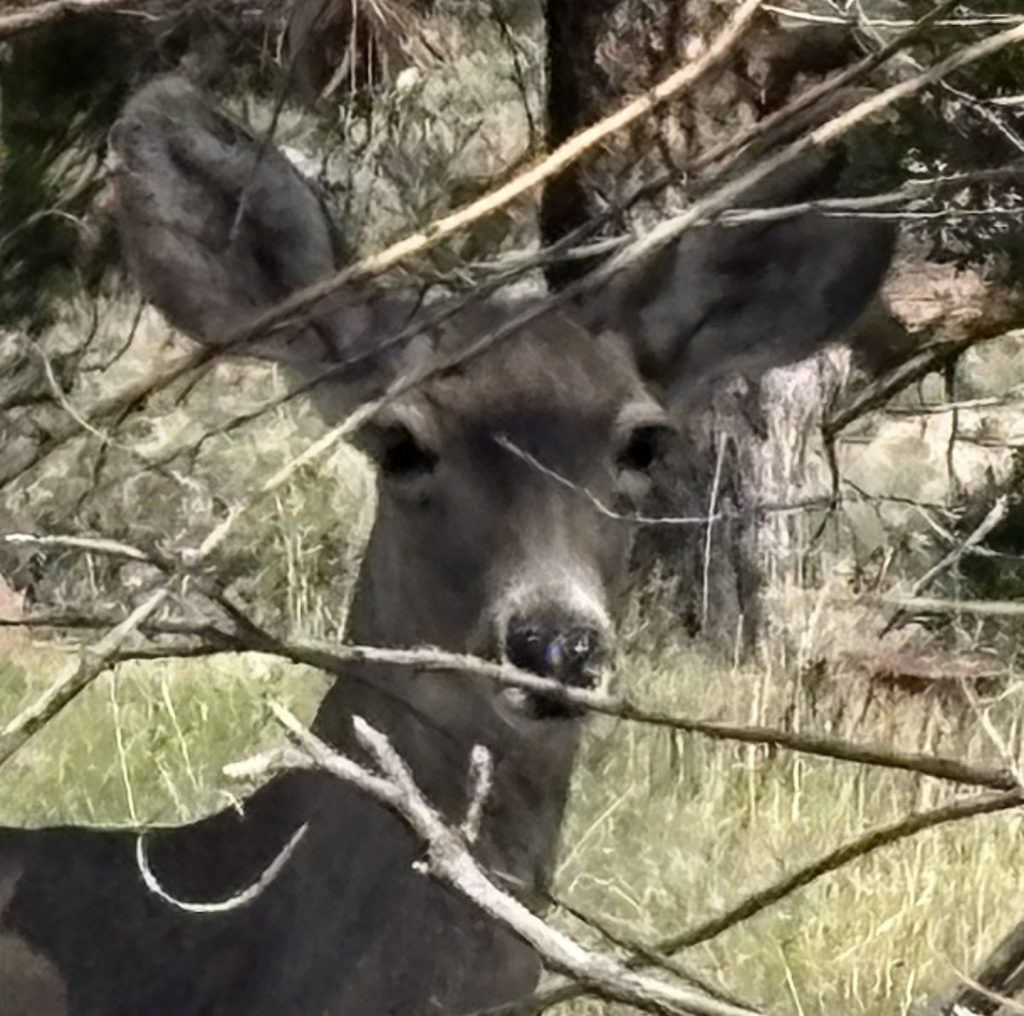
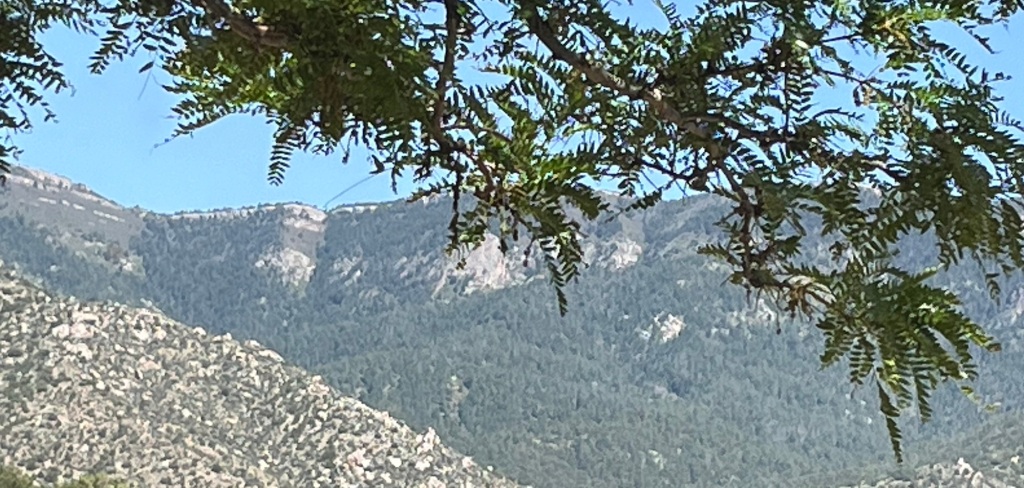
The deer came to greet me today. A small hello before going on their way– Two does and a fuzzy coated fawn. The leading doe stared at me, Assessing me a threat or not. Her head turned, her elegant neck stretched toward me, her eyes softened as she decided— no need to run away.
Her stare continued. For a moment, I sinned. I coveted her innocence, their understanding of the world, these mountains here—
Yes, I know, they know the twins, cruelty and brutality, in ways I can never understand.
But I envy their ignorance of the cruelty and brutality contained within humanity.
I hold a handful of pomegranate seeds— I think of you all I know and do not know--
A bushel of grapefruits arrive at the front door. The next day, a bushel of oranges followed by a bushel of pomegranates, like tribute foretelling the arrival of some dignitary or prince. Every summer, the bushels foreshadowed your visits-- The grapefruits and oranges for my mother, who loved all citrus, a luxury she didn’t have growing up in West Virginia. The pomegranates for me-- You knew I loved them. Why did the bushels and the visits stop after the summer I turned six?
These seeds I hold, ready to throw into today’s salad, are too few—
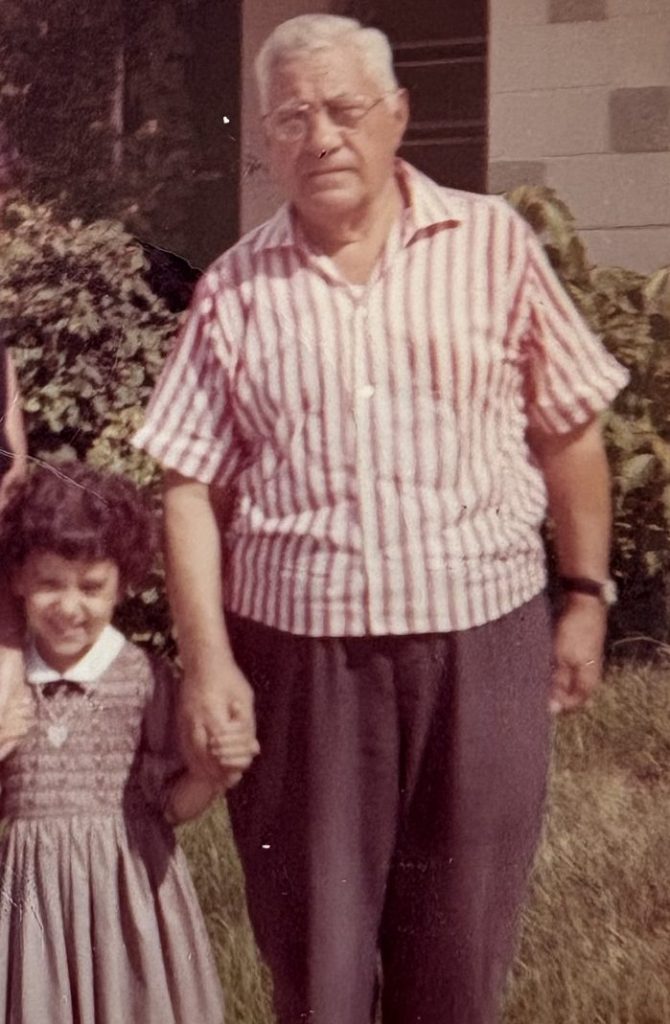
I remember you— showing me how to open a pomegranate; teaching me to count in Greek; moving a stepstool to the counter so I could climb and see how to make Greek yogurt from scratch, when you saw my nose wrinkle at the smell, telling me, “You will like it because you Greek,” your accent as thick and heavy as the clabbered milk in the yogurt glasses.
The last summer you came to visit— A train ride to Florida to stay the whole summer with you and Aunt Mae. I wanted the top bunk in the train car. You tucked me into the lower one saying, “You fall here. No hurt. You fall from up there, you hurt,” before hefting yourself into the top bunk. You said you’d teach me to swim. “Everybody in Greece swim. I teach you. You learn easy because—” you paused, waiting-- for my six-year-old excitement to finish, “I’m Greek!” You tousled my hair then loaded our things in the car.
Everything to be tried, to be learned, to be shown required our liturgical call and response: you would start, “You will like because—" and I would finish, “I’m Greek.”
Teaching me to swim didn’t work out too well— You told me to move my arms and legs fast, then threw me into the ocean. Each time I flailed and sank. Each time you pulled me up, “You okay. You learn.” The third or fourth throw, You pulled me up And said, “Enough today. But you learn because—” And despite my fearful sobbing, I finished, “I’m Greek,” as I wrapped my arms around your neck. We did not have time. I never learned.
Sirens, red lights, dark outside, Aunt Mae crying. The hospital cold, noisy. Mae on the phone. Mommy coming on the train.
You lived. Came home. Peeled me a pomegranate.
Mom and I left on the train. The last time I saw you, Uncle Pete, though you did not die until three months after my high school graduation, an obituary found on the internet tells me so. But the bushels, the visits, the phone calls stopped the summer I turned six. I never knew why. I will never know now.
Fifty-nine years after that summer with you, I stand holding a handful of pomegranate seeds, shining their ruby glow. Decades since last I split open a pomegranate. Too easy to buy in plastic tubs now. I need to finish this salad.
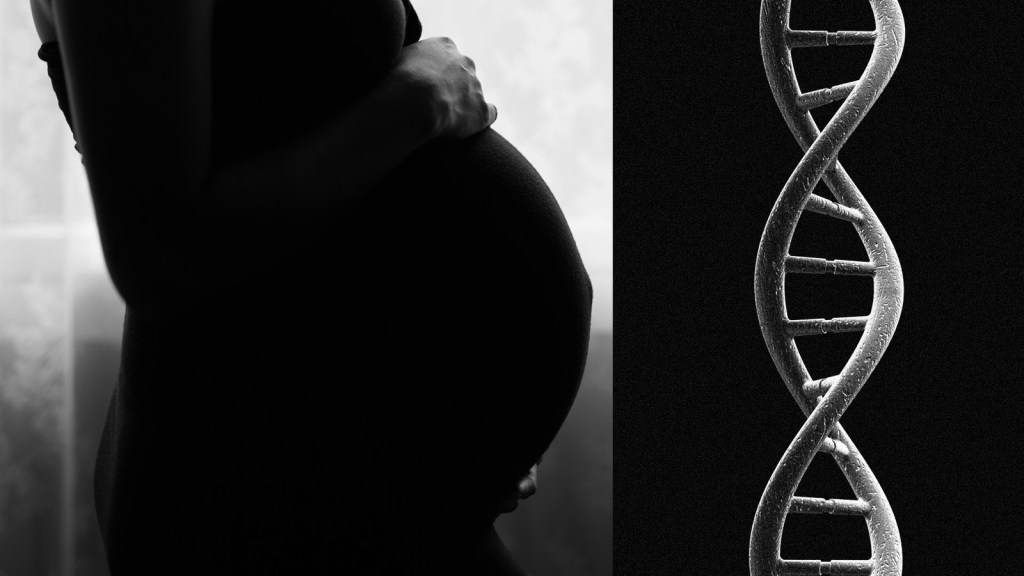
But I am stilled in the moment— The truth I now know— sleuthing through scraps of internet information after a DNA test-- What neither of us may have known that one summer, We were/ are father and daughter.
He covers his sunlit towhead with one of his blankies and loosens glistening giggles.

And I remember what it is to hide. Hiding, a thing of childhood, joyful for this boy of three with his shining towhead appearing sprinkled with glitter in the sunlight and the bubbling raspy giggles he lets loose as he covers and uncovers his shimmering head with his beloved blankie.

I learned to hide from the monster who pursued me. At times, the monster was too angry, too quick, and I had no time to hide. Other times, there was only time to seek refuge behind rustling silk dresses, a molting mink, and piled up shoe boxes—only to be yanked out by an arm, thrown across a room before the whipping began. On rare occasions, there was time to make it to the small bedroom on the third floor where there was a closet over the stairs. The floor of the closet was raised and filled with boxes of junk. The boxes created a barricade against the monster my mother often became when she drank. Though she drank daily, always drunk by the time the evening news came on, the monster did not appear every day. On any particular day, if the monster’s rage began as a slow simmer, I would silently slip away to that closet, crawl over the boxes, and listen as the rage of the drunken monster began boiling below, hoping the stomping monster did not make her way up to the third floor. That third-floor closet never failed. I never allowed myself to breathe in the safety of that third floor over the stairs closet until long after the sounds of raging below stopped. Then, closing my eyes, enjoying the silence, my muscles beginning to relax, I would breathe in the safety found in the darkness.
By the time I was twelve, I had outgrown the safe haven of the third-floor closet.  There was no way to crawl over the boxes without knocking them over and making noise. My hiding place lost; I had to find a new one. One I created—not truly safe or a hiding spot, but an escape. A way to stand and take the whippings of yardsticks, wooden then metal, without a cry or a whimper, to use my mind to create an escape, a place my body could not go, yet my mind could fly in moments to the safety of silent blackness.

This little three-year-old towheaded boy, finished with his hiding game, asks for cold, frozen, blueberries. Upon discovering there are no cold blueberries left, he wails. A grieving wail with fat tears. It is tragic, this absence of cold blueberries. And all I can do is find a distraction for him. But I smile and I am teary eyed at this dramatic switch from joyous laughter to tragic grieving loss of cold blueberries because he knows he is safe. He can go from laughter to tears because he does not doubt his safety here in this place among these hearts within this room filled with sunshine.

Later, when I hug and kiss him goodnight, I say a silent prayer that he never knows what it is to seek safety in darkness and only ever knows what it is to feel the safety offered in the warmth of sunshine.
The words, the words--
They rattle in my head,
louder than
the tail of a snake,
louder than
the breaking of stacked billiard balls,
louder than
the concussing jack hammer on a city street--
too much noise to hear distinctly
what must be written,
what must be said, screamed
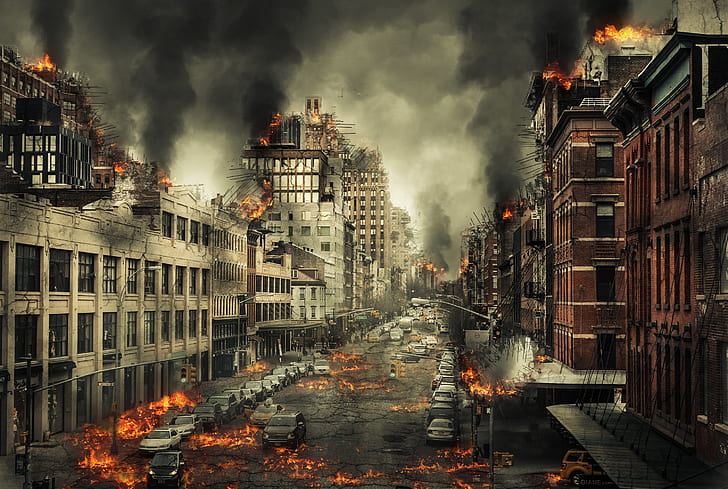
into the foul fiery smoke-filled air

One word, one.
Just one, larger than the others,
louder—
settles against my skin,
a lash of fiery noise,
burning, burning deep--
betrayal--
burning away tiny scars
of other betrayals
a lifetime ago

This wildfire of betrayal
burns away
soul held beliefs
of common good.
Fifteen minutes later, six bodies forgotten in the collected dust of memory upon the world.
Six souls passed away, imprisoned from the light of God. The sky shrinks away from the edge of earth as the six join 1139.
I did not know any of them. Not one soul. I did not have a friend, a neighbor, a brother, a sister, a father, a mother, a cousin, an aunt, an uncle, no son, no daughter among them. But I mourn them, as if I knew them, as if they were family. I feel the empty spot they left upon leaving the world.
You ask me why I feel their loss so… My answer—because I am human. In return, I ask…Why do you not feel it so?
No answers found in the mocking caw of crows who laugh at humanity.
Sitting here in New Mexico and looking at these mountains, I wonder if my mother ever heard the mountains of Appalachia sing as I do these.
The mountains sing their history--
of when they knew only tranquility
in the land of their ancient salt seas,
when the sun could not touch them,
when they were virgin still--
safe from the rough hands of the wind,
long before the rise of humanity.

Their song holds the rhythms,
the bars, the layers of the time before--
before an angry molten core,
containing not a single drop of mercy,
drove them from their ancient, peaceful home,
forcing them to be refugees in the kingdom
of sun and wind.

Their song holds the rhythms
of all they grieve
in witnessing humanity’s rise,
dripping in eternal inhumanity.

At the feet of the mountains, the lilacs,
nourished by snow melt tears,
bow their heads and dance in the rhythms
of the mountains’ song—
A dance of homage
to such ancient ones.
Forgive me, I ramble,
telling you of life at sea level--

where a steady pour of hours stream,
and minutes bead against the windowpanes
as the seconds mist into fog--
decades of earth and rock liquify--
A mottled mix of flowing colors and viscosities
defiant and devoid of any beauty
to ease a slippery sharp-edged flow
carving out an emptiness
within this near ghost of a soul
waiting in unacknowledged darkness,
while asking for a way to the light—

before waking in the softness
of morning at altitude.
A gray morning starts the day.

A light dusting of wet snow

greets me and the dogs

before my coffee and breakfast

can have a say in the matter.


And you are no longer

in this world

to see the same sky

or to visit me here.


The last twelve years

we made up for

the lost years of the forty-eight

we’ve been friends--

Our marathon talks about our kids,

our hopes and worries for them,

the birth of your grandchildren,

the death of my wife,

the blasphemous betrayal of aging--

all our griefs and our celebrations.


Sharing, as adults, the things

We could not share as kids,

how we survived the fog bank

attack of our mother’s hearts

upon our own to live our lives

in the sunlight of the earth.

You were the one to word it best-

Like the little girl with the curl

in the middle of her forehead:

When they were good,

they were very good

and when they were bad,

they were horrid.


How often, always it seems to me,

you bested me in our repartees of humor and wit,

until I did cry, Uncle, I give!

The two of us laughing,

fighting hard to catch our breath.


In the end, your body betrayed your spirit.

I would rewrite your ending if I could.

I’d write you healthy for years to come,

running and playing with your granddaughters,

seeing graduations and weddings—

Of course, selfishly,

I’d write you many visits

to see me here in this mountain paradise

of a place where I am blessed to be.

Where we’d sit—

you sipping your Jameson Irish Whiskey

and I my glass of wine,

as we laughed and teased each other

in our merciless way.

Then you’d talk of your son

and I my daughter,

what motherhood meant,

and how we survived our own mothers.

I’d write you happiness,

finding love with an Andy Garcia

look alike who would worship you.

I’d write your ending

with a pain free body,

sitting in the sun

while you watched

your great-grandchildren at play.

Finally, selfishly,

I’d rewrite feeling your absence

from this world.
To participate in the Ragtag Daily Prompt, create a Pingback to your post, or copy and paste the link to your post into the comments. And while you’re there, why not check out some of the other posts too!
Showcasing the best of short films and screenplays from the LGBTQ+ community. Screenplay Winner every single month performed by professional actors. Film Festival occurs 21 times a year!